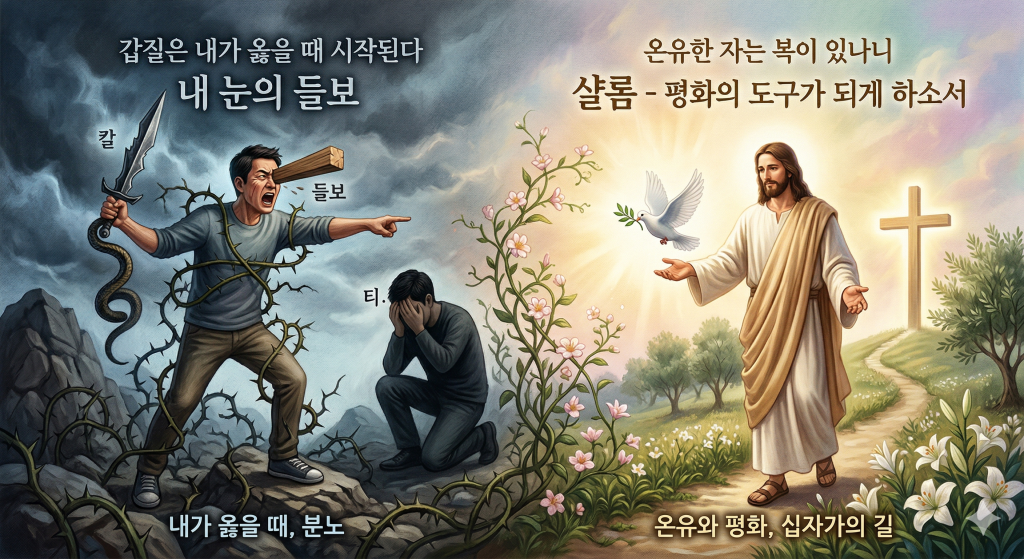
식당에서 손님이 종업원을 향해 모욕적인 말을 한다. 왜 그랬을까? 손님이 받아야 할 정당한 대우를 종업원이 침해했기 때문이다. 어떤 아이가 학교에서 폭력을 저질렀다. 왜 그랬을까? 그 친구가 약 올렸기 때문이다. 눈에는 눈, 이에는 이. 이게 정의처럼 보이지만, 갑질은 언제나 내가 옳을 때 시작된다. 아이가 잘못했기 때문에 훈육한다는 것이 죽이기도 한다.
하지만 예수님은 온유한 자가 복이 있다 하셨고(마 5:5), 너희 원수를 사랑하며 너희를 박해하는 자를 위하여 기도하라 하셨다(마 5:44). 십자가의 길은 칼을 들어 보복하는 것이 아니다. 칼을 쓰면 망할 뿐이다. 갑질하는 사람은 상대방이 얼마나 내게 잘못했는지, 그 사람이 얼마나 나쁜 짓을 했는지를 말한다. 하지만 그것은 자신의 갑질을 정당화할 수 있는 것이 아니다. 사실 자기 자신에게는 얼마나 더 많은 잘못이 있지 않은가? 내 눈의 들보는 숨기고, 다른 사람의 티만 보면서 자신의 폭력을 정당화하는 것은 넓은 길이다. 우리는 예수님께서 가신 좁은 길을 가야 한다.
사실 분노는 언제나 정의롭다. 우리의 마음 가운데 분노가 생기는 것은 내가 정의롭기 때문이다. 우리는 하나님의 형상으로 창조되었기 때문에 정의를 추구하게 되어 있고, 정의가 이루어질 때 편안한 마음을 느낀다. 그런데 정의롭지 못한 상황을 만나게 될 때, 우리는 불편함을 느끼며 분노를 느끼게 되어 있다. 그런 점에서 분노는 한편으로 정당하다. 정확하게 말하면 분노를 느끼는 그 감정 자체에는 죄가 없다.
하지만 문제는 그 분노를 어떻게 표현하는가이다. 우리는 본성적으로 죄성으로 가득한 존재이다. 그래서 우리가 불의한 것을 보았을 때 나타내게 되는 최초의 즉각적인 반응은 사탄적일 수 있다. 그 분노를 화로 표출할 수 있고, 때로는 폭력으로 표현할 수도 있다. 분노의 감정을 어떻게 표현하는가가 중요하다. 갑질을 하는 것은 분노의 감정을 잘못 표현한 것이다. 눈에는 눈으로 갚는다고 했는데, 사실은 몇 배로 악하게 갚은 것이다.
그래서 성경은 우리에게 권면한다. “분을 내어도 죄를 짓지 말며 해가 지도록 분을 품지 말고 마귀에게 틈을 주지 말라”(엡 4:26-27). 분노의 감정이 생길 수 있지만, 그것을 죄를 짓는 방향으로 표출해서는 안 된다는 의미이다. 그리고 처음에 가졌던 그 분노의 감정도 해가 지도록 품고 있지 말고 누그러뜨려야 한다. 우리에게 분노의 감정이 생기는 것까지 막을 수 있는 사람은 없다. 마치 우리 위로 새가 날아가는 것을 막을 수 없듯이 말이다. 하지만 그 분노의 감정을 우리의 마음에 계속 머무르게 할 것은 아니다. 새가 우리의 머리 위에 둥지를 틀게 하는 것은 막아야 하고, 또 막을 수 있듯이 말이다.
사실 분노는 내가 옳을 때 나타나는 감정이기는 하지만, 내가 옳다는 판단은 지극히 주관적이다. 내가 옳다는 판단을 내리게 되는 이유는 남의 눈에 있는 티만 바라보기 때문이다. 내 눈 속에 들보가 있는데도 보지 못하기 때문에 내가 옳았다고 착각할 뿐이다. 우리의 마음과 눈은 언제나 편파적이다. 나에 대해서는 한없이 관대하고 이해할 만하며, 타자에 대해서는 언제나 납득할 수 없고 용서할 수 없다. 이러한 현상은 어쩔 수 없다. 내가 나의 상황에 대해서는 잘 알고 있지만, 다른 사람의 상황은 다 알지 못하는 한계가 있기 때문이다. 그래서 항상 내가 옳고, 다른 사람들은 이해할 수 없다.
이것을 극복할 수 있는 방법은 하나뿐이다. 타자 속에서 나 자신을 들여다보는 것이다. 사실 다른 사람에게서 보이는 악한 모습이 바로 나의 모습이라는 사실을 직시하는 것이다. 내가 만일 그 사람의 상황에 있었더라면, 나도 그렇게 행동했을 것이 분명하다. 그래서 예수님께서는 “네 이웃 사랑하기를 네 자신과 같이 사랑하라”고 하셨다(마 22:39). 사실 그게 성경 전체의 가르침이다. 내 앞에 있는 그 사람의 모습에서 나 자신을 들여다보아야 한다.
하지만 일만 달란트를 탕감받았던 종은 백 데나리온을 빚진 자에게서 자신의 모습을 보지 않았다(마 18:21-35). 그래서 자신에게 빚진 자를 감옥에 처넣었다. 사실 그게 자기 자신을 가두는 것이라는 사실을 알지 못한 채 말이다. 칼을 쓰면 칼로 망한다. 칼은 상대방을 깨끗하게 없애버려서 내게 완전한 승리를 가져다줄 것이라고 사탄은 끊임없이 우리를 유혹한다. 하지만 그 칼끝이 자기 자신을 겨누고 있다는 것을 알아야 한다. 그 칼을 휘두르면 내가 죽는다.
샬롬(평화, 화평)을 추구하는 자가 하나님의 자녀이다(마 5:9). 칼을 휘두르면서 하나님을 믿는다고 하는 것은 위선일 뿐이다. 하나님께서는 이웃을 향해 칼을 휘둘러 피를 흘리는 사람의 기도를 듣지 않으신다(사 1:15-17). 하나님께서는 마지막 날에 물으실 것이다. 내가 굶주릴 때 너는 무엇을 하였느냐? 내가 나그네 되었을 때 너는 무엇을 하였느냐?(마 25:31-46). 그건 개인도 마찬가지고 공동체도 마찬가지이다. 참된 승리는 전쟁을 하지 않고도 승리하는 것이다. 누군가 공격해온다면 할 수 없이 방어적 무력을 사용해야 하겠지만, 가능하면 전쟁을 피하는 게 이기는 것이다. 사실 총칼을 사용하는 것은 가장 어리석은 자의 선택일 뿐이다.
주여, 나를 평화의 도구가 되게 하여 주소서. 그게 우리의 기도가 되어야 한다. 십자가의 길이 승리의 길이다. 예수님께서 부활하고 승리하시지 않았는가?
When Righteousness Becomes Violence: The Trap of Self-Justified Anger
In a restaurant, a customer speaks insultingly to a waiter. Why? Because the customer feels the waiter has violated the “proper treatment” they deserve. A child commits an act of violence at school. Why? Because a friend teased them. An eye for an eye, a tooth for a tooth. This looks like justice, but “gap-jil” (the abuse of power) always begins when I believe I am right. Disciplining a child because they did something wrong can sometimes escalate to the point of killing them.
However, Jesus said that the blessed are the meek (Matthew 5:5), and He told us to love our enemies and pray for those who persecute us (Matthew 5:44). The way of the cross is not taking up the sword to retaliate. If you use the sword, you will only perish. A person who abuses their power speaks of how much the other person wronged them or how badly that person acted. But that cannot justify one’s own abuse of power. In truth, do we not have far more faults within ourselves? To hide the beam in one’s own eye while looking only at the speck in another’s eye to justify one’s own violence is to walk the “wide road.” We must walk the “narrow road” that Jesus traveled.
In fact, anger always feels righteous. Anger arises in our hearts because we believe we are being just. Since we were created in the image of God, we are designed to pursue justice, and we feel at peace when justice is served. Conversely, when we encounter an unjust situation, we are wired to feel discomfort and anger. In that sense, anger is, on one hand, justifiable. To be precise, there is no sin in the emotion of feeling anger itself.
The problem, however, is how that anger is expressed. By nature, we are beings full of sinfulness. Therefore, the first immediate reaction we manifest when we see something unrighteous can be satanic. We may express that anger as rage, and sometimes as violence. How we express the emotion of anger is what matters. To abuse power (gap-jil) is to express the emotion of anger wrongly. We say we are paying back an eye for an eye, but in reality, we often pay it back many times more wickedly.
Thus, the Bible exhorts us: “Be angry and do not sin; do not let the sun go down on your anger, and give no opportunity to the devil” (Ephesians 4:26-27). This means that while the emotion of anger may arise, it must not be expressed in a way that leads to sin. Furthermore, even that initial feeling of anger must be softened and not held onto until the sun sets. No one can prevent the emotion of anger from arising, just as one cannot stop a bird from flying over their head. However, we must not allow that emotion of anger to dwell continually in our hearts—just as we must and can prevent a bird from building a nest on our heads.
Actually, while anger is an emotion that appears when I am “right,” the judgment that I am “right” is extremely subjective. The reason we judge ourselves to be right is that we only look at the speck in the other person’s eye. Because we fail to see the beam in our own eye, we merely fall under the illusion that we are right. Our hearts and eyes are always biased. We are infinitely generous and understanding toward ourselves, while we find others constantly incomprehensible and unforgivable. This phenomenon is unavoidable because there is a limit: I know my own situation well, but I cannot know the full situation of others. Therefore, I am always right, and others are incomprehensible.
There is only one way to overcome this: to look at oneself within the “other.” It is to face the fact that the evil seen in another person is, in fact, my own reflection. If I had been in that person’s situation, I surely would have acted the same way. This is why Jesus said, “You shall love your neighbor as yourself” (Matthew 22:39). In fact, that is the teaching of the entire Bible. We must look at ourselves in the image of the person standing before us.
However, the servant who was forgiven a debt of ten thousand talents did not see himself in the one who owed him a hundred denarii (Matthew 18:21-35). Thus, he threw his debtor into prison, without realizing that he was, in fact, imprisoning himself. Those who use the sword perish by the sword. Satan constantly tempts us by saying the sword will cleanly eliminate the opponent and bring us total victory. But we must realize that the tip of that sword is pointing at ourselves. If I brandish that sword, I die.
Those who pursue Shalom (peace, peacemaking) are the children of God (Matthew 5:9). To claim to believe in God while brandishing a sword is mere hypocrisy. God does not hear the prayers of those who swing the sword and shed blood toward their neighbors (Isaiah 1:15-17). On the last day, God will ask: What did you do when I was hungry? What did you do when I was a stranger? (Matthew 25:31-46). This applies to individuals and communities alike. True victory is winning without going to war. If someone attacks, one must use defensive force of necessity, but winning is avoiding war whenever possible. In truth, using guns and swords is simply the choice of the most foolish.
Lord, make me an instrument of Your peace. That must be our prayer. The way of the cross is the way of victory. Did Jesus not resurrect and triumph?